Ergonica Presents Poetry and Inspiration to Groom Your Garden
Zen Weeding
: The Art
|
| Weeds happen because life happens! We all need to be thankful for the urgency of life to happen, evolve and persist. It's all a wonderful and crazy phenomenon depending on where you stand in the pecking order of animate things before you. Most of us spend a significant portion of our gardening hours removing and controlling misplaced plants (weeds). Do we enjoy these hours or do we dread them? Can weeds threaten your existence? Any plant species that has survived the hundreds of millions of years it took to arrive at the present era has acquired some very ingenious and aggressive strategies for disseminating it's seeds and flourishing wherever the winds or tides may take it. With all the efforts humans take to eliminate many of these plants, it stands to reason that the successful species of the future may be even more aggressive and adaptable to a variety of threatening situations including the chemicals we use to assault them. Let's face it, billions of years ago living cells like bacteria learned to thrive and survive in the sphere of small molecules and chemicals, many of which they created on their own. The chemical warfare of living entities amongst themselves and environmental threats is as old as life itself! Larger, more complex organisms including plants, trees, fish, birds, apes and humans can do their best to muster the wisdom of ancient molecules that defined the structures of their evolutionary ancestors and continue to thrive and enliven their bodies and activities. To the most simple or complex living species of today, any chemical threat, whether natural or artificial, is simply another day (among billions) in the office of survival. Life is about chemicals, molecules, and structures that support the same. In addition to agricultural corporations that spend millions of dollars on noxious chemicals to kill noxious weeds, there are university scientists whose entire careers are devoted to finding and destroying the green invaders. Now, I have learned, even NASA has joined forces with government agencies to pinpoint the locations of invading plants from satellites and predict their movements. Next, I expect our Homeland Security efforts are likely to add alien plants to the list of security threats. Notwithstanding all the above, none of the experts have ever published a statement indicating that the War On Weeds will be won during our lifetimes. Zen Weeding: At Peace with Weeds...To get into the Zen attitude of weeding, we should observe that, whereas agriculture has to be efficient, ornamental gardening does not. There is no product and no harvest in gardening. We don't take our dead leaves and grass clippings to market and bring home a check for our labors. Zen weeding is the art of understanding that when we take the efficiency concept and urgency out of gardening, all that's left is the beauty of enjoying the time we allow ourselves to be so close to nurturing favored plants and understanding how things grow and die. Much like painting a still life art object, the enjoyment is in the act of painting itself and the concern for efficiency is irrelevant. Clipping a branch is a brush stroke. Twisting a weed is a brush stroke. Planting a new rose bush is a brush stroke. Take your time and enjoy the moment, the scene, the event. The topic of gardening versus farming efficiency is discussed in more detail in the Weed Twister website on the use of postemergent herbicides. Reading some of the beautiful poems we have selected on weeds will also help you develop a calming and appreciative attitude towards weeds. Outlaw WeedsLegislation to outlaw the movement of specified noxious weeds has been enacted by the U.S. federal government, most states and numerous counties. Under the Federal Noxious Weed Act of 1974 , the Secretary of Agriculture has the authority to prohibit the importation and interstate transportation and sale of species that the Secretary has deemed noxious through actions such as inspection and quarantine. The Secretary is allowed to seize, treat, destroy and dispose of items that have been contaminated with a noxious weed. Similar laws also exist in many other countries in all parts of the world. In at least one country, the jacaranda tree has become the subject of state control for political reasons. Recently, the local government of Pretoria has sent out weed inspectors to impose $900 fines on those who fail to rip out jacaranda seedlings, although large adult trees will be allowed to remain. Pretoria is a squat, uniform city with streets on a grid pattern, but it is spectacularly beautiful in spring when the streets are purple with petals from jacaranda trees. It is known as the "city of jacarandas," but that is another aspect that may eventually be expunged, because the trees are not a native African species. The government is also planning to change the name of Pretoria to a more pre-colonial name. Are there any politically incorrect trees in your town? Thinking of weeds and agriculture, I recently got inspired to write an essay about the impact of agriculture on the evolution of species. There seems to be two conflicting philosophies about saving native plants. It's OK to remove every native plant and erase the related ecology wherever we care to grow the monoculture crops we eat and feed to our livestock and ship around the world as food or ornamental plants or building materials. But, it's NOT OK to remove or endanger our native flora and fauna in the areas where agriculture has no interest. If you care to dwell on this issue, read the essay On the Semantics of Evolution available from the free downloads page. Aerobic GardeningThere's been a lot of talk, here and there, about speed gardening and high speed gardening. I imagine one changes gears to advance to the higher speed version. There's even reference in one page about "lunging and weeding": using a hand weeder you lunge forward, keeping one leg straight back and the other leg bent with the knee in front. This sounds kind of dangerous to me, but, I seldom bend down when weeding because I use my trusty Weed Twister. Perhaps some of our Ergonica friends may start their own trend by focusing on high speed weeding? Now, I'll have to try to think of a speedy weedy way of removing weeds with my Weed Twister, in order to keep up with the latest trends in gardening. Or, I could let the work crews on farms in California and other states show me the way they do it! Anything I've seen done by farm workers has been done most rapidly and efficiently. We have recently introduced an industrial model of the Weed Twister which has stronger and thicker steel, sharpened tines and three models with lengths of 36, 42 and 48 inches. We could try to train the workers on the best techniques we know on using the tool, or we could just put it in their hands and video their progress. In one day, we will probably have world records on speedy weed removal with the Weed Twister! For suggestions on speedy techniques of weed twisting, see the Weed Twister website Rapid Sweep Hoeing drill. It's the randomness of misplaced plants that can be a cause of frustration. I've come to accept this randomness as a playful challenge: "... It's fun to randomly attack ... The weeds that thrive on happenstance." This is a passage from my poem Herb Keeper in which I relate my gardening experience. If the weeds can surprise me by popping up in unexpected places, I can also surprise them by yanking them out with my bear fingers upon first sight. Sometimes I think they hide from me when I'm carrying my Weed Twister. Whether I'm in the mood for a speedy weeder or a Zen weeder, my twister is like an extension to my hand and fingers. Do I hate the misplaced plants? Absolutely not. In fact, I've developed much of my garden by throwing water in uncultivated areas and waiting to see what pops up. If it's a clover or a broad-leafed ground cover, I might let it thrive and nourish it. But it's my garden, and I'm the Herb Keeper, so, as I say in my poem: But I admit, I need the green. Even though I enjoy using my fingers from time to time to feel the soil and the texture of the leaves, I also recognize that the right tool can often get the job done more efficiently and gracefully. For us weeding procrastinators who wait till weeds grow large and deep before we address the problem, a tool to handle bigger weeds is always good to have around. In agriculture, the limitations of cultivation, herbicides, flaming and hand weeding often leave behind large weeds, such as mallow, for example, that resists Roundup and is most difficult to remove with ordinary tools or by hand. This is where the art comes in. I don't claim to be a surgeon or a perfectionist, but I usually wield my hoe, my Weed Twister and my dandelion weeder in deft maneuvers as I assess each new situation. Since my home in the Highland Park area of Los Angeles is surrounded by wild grass on three sides, I've had many opportunities to hold the line using many different strategies and tools. Actually, I've contained the weeds in back of my house, using primarily my Weed Twister over the past several years, so now I have wild weeds on only two sides. These hillsides are my weed laboratories. The hoe and the short handled dandelion remover are indispensable pieces of equipment. I have also experimented with other tools like my Weed Twister, that all promise to save your back and eliminate stooping and kneeling while effectively removing individual plants. Of course, I'm not as objective as you may be, but, if you think a tool of this type may enrich your gardening experience, I would urge you to try out one or more of these tools. Take a look at the Weeder Features Chart to help you classify the various types of weeders available on the web market today. To see what some weed scientists think about our mechanical solutions to weed removal, you may peruse this book listing on Google Books: Fundamentals of Weed Science. Keep in mind that weed scientists are more concerned about agricultural applications than home gardening. When you enter an industrial farm you may need to wear a gas mask. For persons with physical limitations, I have found some interesting books to aid in planning a garden and working with limited strength and mobility. For example, a couple of very readable books are The Enabling Garden : A Guide to Lifelong Gardening by Gene Rothert and Accessible Gardening for People With Physical Disablilties : A Guide to Methods, Tools, & Plants by Janeen R. Adil. There are also several good suggestions in an article Aerobic Gardening for Seniors from Ritecode. More weeding tips for all types of people have been noted in the Weeding Tips page. In my experience, the Ergonica Weed Twister beats all the competitors hands down. It's a graceful tool, with no moving parts that effortlessly penetrates the soil as you twist the coiled tines. The weeds remain in the coil allowing you to dispose of them without having to stoop down to the ground. |
HIGH SPEED WEEDING - You can do it! (Carefully)Ray Cruz Poetry
You can also download several poems in a PDF or Word file.
|
Admittedly, I like using well crafted tools for various jobs around the house and garden. If all I wanted were to get the job done, I could hire a maintenance man. It's not a chore, it's an experience, an art.
To twist or not to twist?
That is the question...
To twist or to Ergotwist?
Therein the rub!
I twist, ergo I don't exist -
A weed's epitaph
Weed Twisting is not just a special procedure but a unique experience, as well. Especially if you're using the unique Ergonica Weed Twister. We think this experience deserves a new word: Ergotwist™. Like the name Ergonica, the "ergo" refers to ergonomic products and added value. Ergotwisting is an ergonomic method of twisting out weeds using the Ergonica Weed Twister. It is also an important factor for sustainable agriculture by penetrating deep into the soil with a minimal amount of soil disturbance - a low-no-till solution. Permaculture advocates and organic growers will appreciate the virtues of this special method to remove unwanted plants, be they weeds or voluntary potatoes. Even if there were no weeds in this beautiful planet, there would still be plants, alive or dead, that need to be moved, removed, extracted or harvested by tools or processes that hopefully are minimally disruptive to the soil. After all, it's the soil that feeds the plants that feed the animals including ourselves and those we eat. To put it bluntly: Cultivate carefully!
Grooming your garden may also include adding comfort for your pets. Safety is also a concern when you apply poisonous pesticides in the same space your pets use for play or doing their business. Protect your pets with special fencing in your backyard and gates in your home to prevent your pet entering a dangerous place. A special pet camera can also give you a view of what your pet is doing or encountering when you're away. There are also a variety of feeding and watering devices to make sure your pet is not going to starve if you get stuck in a major traffic jam. Being in the dog house may be a treat in harsh weather when your dog is left outside, especially with a nice bed. Pet doors come in different sizes and shapes as well as automatic doors triggered by special collars designed for security. Pet clothing can also help during harsh weather.
After grooming your garden you may decide to groom your pet. In addition to brushes, special grooming tools are available such as scissors, clippers, combs, nail grinders, clamps, dryers, tables, lotions and more. Beyond grooming and cleaning your pet, there are also special vitamins to keep your pet in good shape, as well as healthy treats to make your pet feel good. A few pet toys are sure to inspire your pet to Zen, especially if you join your pet in play! Meditate on pet zen... While meditating, you may find it interesting to explore many other useful and fun accessories and handy materials and books pertaining to pet care including special resources for birds, cats, dogs, fish, hamsters, rabbits, reptiles (snakes, lizzards, iguanas, etc.) and turtles. Please be careful with those snakes! Make sure your pets are compatible before you place them near each other. You don't want to feed your cats a beautiful costly bird!
| Wild birds can invigorate your garden with fascinating bird calls and colors. But they can also fall prey to your cats and other pets, especially if you feed them on the ground. Even if you use special wild bird feeders, some fencing under the feeders can help to provide at least a partial barrier to protect birds that feed on seeds falling or tossed to the ground by birds. Several types of wild bird feeders that can add natural zen to your backyard ecosystem include Hummingbird, Oriole, squirrel proof, suet, thistle, hopper and tube. You can also accomodate your wild birds with a bird bath and a bird house or two. Some bird toys can make it more fun for both your wild birds and pets in cages. Having a hummmingbird feeder in your garden doesn't guarantee that hummingbirds will flock to your spot. They are also drawn to many other flowering plants, especially those with trumpet-shaped blossoms. Actually many such floral species in evolution adapted specific shapes to attract hummingbirds specifically and to enhance their help in spreading pollen. The long shape of the trumpet blossom can reach over the lengthy beak to dust the bird's head with pollen. Hummingbirds are also regional and migrate from South America to Canada along the Pacific Coast every year. You won't find them on the East Coast, for example. Some hummingbirds have found a nearly permanent home in California. But birds don't know borders, and sometimes they jump to places never spotted before. For example, we recently spotted a Northern Cardinal in our California backyard that is only officially known to reside on the Northeast part of America and to some extent as far west as Arizona. For proof, we present a short video of this Northern Cardinal sighting. Here, you will also see a variety of wild bird feeders in what we call our bird spa. Although Cardinals are not seasonal migrators, they do get around. Perhaps it's just the American Go West! spirit? A Hooded Oriole also visited this spot (a few days earlier) in spring 2016. We see a few migrating Hooded Orioles in our bird spa every spring. There are some excellent Birding Guides to help you learn more about the birds in your own backyard. Explore the tree menu at this link for birding guides in specific regions and states. |
Northern Cardinal Spotted in Southern California |
Squirrels - Birds - Rats! ** Do Rats Eat Your Bird Food at Night?In addition to squirrels, rats can also devour a lot of food you buy for birds. You may see the squirrels in the day but later on the night shift may take over. We have found that rats can nimbly crawl over obstacles impossible for squirrels. You may not know how much of your bird seed is fattening up neighborhood rats. A video we prepared can document this menace and also show some ways to protect your food from rats, squirrels and other rodents, too. Although we squirt the squirrels with hose water at the start, the careful placement of plastic bottles and vinyl sheets curtails their invasion into places reserved for birds with no violence necessary. We also prove that squirting doesn't work, because only minutes later the moochers will come back! Squirrels and rats can share the water trough and feast on scattered seeds to spare. But when they grab your feeders, unless they're well protected, the food will disappear. Beyond the small price of plastic bottles and vinyl sheets, the real cost is the unsightly appearance of plastic bottles and sheets. But, once we know what works, we can attempt to improve upon esthetics as we progress. Watching squirrels and rats climbing on our bird feeders is never copacetic! Warning - towards the end of this video, a swarm of rats attacks! Not pretty! |
Squirrels vs Birds vs Rats - How to Defend Bird Feeders from Rodents |
It's no secret that your dog (and some cats, too?) will love to go for a walk. Naturally you need a proper leash and collar, ID tag, and in some cases a special stroller may be needed. Some dogs may need a muzzle if they are not well behaved or are in training. Pet training may be aided by whistles and other training devices. To transport your pet safely in a car, it's best to use a pet seat belt that fits your pet and in some cases a special carrier or cage may also be needed. Larger dogs sometimes need a ramp to help climbing into your vehicle, especially for older labs with arthritic hips, for example. You don't want to injure your own back by lifting a heavy dog to prevent your pet's back pains! Some great examples of pet houses you can purchase today are shown below...
If you need to check your attitude towards garden
grooming, perhaps reading my poem  Herb Keeper
may point you in the right direction. The more romantic
Valentine poem provides links to
beautiful flowers I picked for your enjoyment. Chances are
I'm preaching to the choir, but I would appreciate your comments
on any of these issues. I have been inspired by a number of creative and
crafty poems about weeds submitted for our weed poetry contest.
Maybe you will also be inspired to write a few words, as well. To give you
a hint about our criteria for selecting winners, we like longer, poems, not
little limericks. We also do not want a direct promo about any
product, including our Weed Twister.
Herb Keeper
may point you in the right direction. The more romantic
Valentine poem provides links to
beautiful flowers I picked for your enjoyment. Chances are
I'm preaching to the choir, but I would appreciate your comments
on any of these issues. I have been inspired by a number of creative and
crafty poems about weeds submitted for our weed poetry contest.
Maybe you will also be inspired to write a few words, as well. To give you
a hint about our criteria for selecting winners, we like longer, poems, not
little limericks. We also do not want a direct promo about any
product, including our Weed Twister.
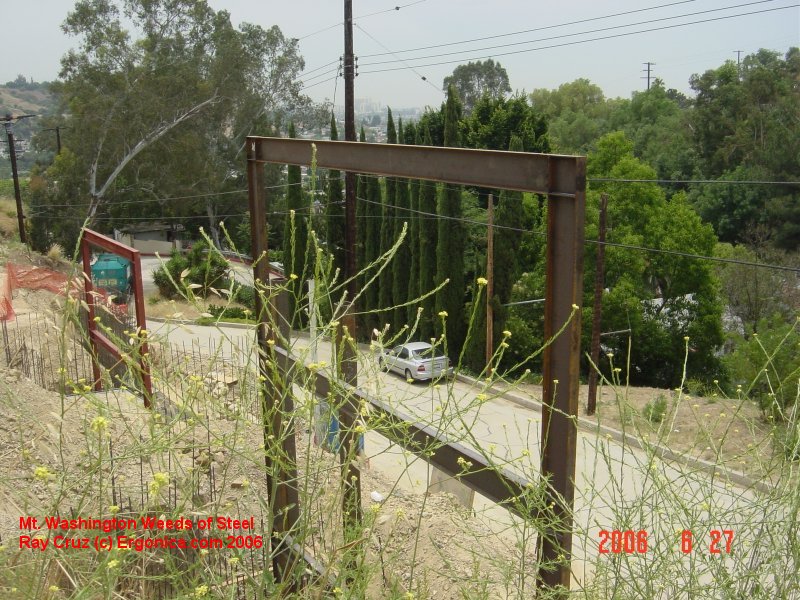
A new genus of weeds is creeping up behind my house on Mt. Washington in Northeast Los Angeles, California. Dubbed, Weeds of Steel, Ferronus Altissima, the image below documents a typical growth of this vigorous flora (behind the mustard weed). These weeds are immune to standard herbicides and integrated pest management techniques. Ergonica, in consultation with Dr. Yucca, is currently researching various mechanical tools that may effectively control the rapid spread of this noxious species. Note that all native flora in the proximity are destroyed by this devastating plant. This construction site, by the way, has also attracted the attention of desperate burglars.
Mt. Washington Weeds of Steel
Luciframe (Ferronus Altissima) and Treebar (Ferronus Rebaris)
A new genus of weeds has been observed on Mt. Washington in Northeast Los Angeles, California. Ferronus Altissima, or Luciframe, can be seen advancing on all sides of the mountain. The primary agent for seed distribution appears to be irresponsible land developers. Ferronus Rebaris , or Treebar, at the flank of the road, is often associated with the larger F.Altissima species which stands in the center with a dark, rusty color, along with another variety towards the left background with a red-orange hue. You can now see the blossoms of this weed in full maturity at 3821 Glenalbyn Drive. Perhaps it's not a weed after all?
If you read the winning poems, you will see how the content varies extensively about gardening and non-gardening areas of interest, including human relationships, values, life and philosophy. We see gardening as a rich human cultural tradition, not merely making plants grow to cover barren soil. If you meditate, you may wish to think about the humor of weeds. How do weeds add value to your life? If you engage in speed weeding, perhaps you may share your experience with us in the form of a poem? More philosophically, what can weeds teach us about peace and harmony in the world?
Musings of Dr. Yucca: Let your garden thrive! A safe and sane delight..…
Please recommend this site to your friends by e-mail. Mention this page in your comments.
The direct link to this page is www.ergonica.com/grooming.htm
 of
Managing Misplaced Plants
of
Managing Misplaced Plants