Why the table
knife test? Ever wonder if your soil needs some
attention, like tilling or aerating? How often does
your soil need to be turned over? Depending on the
kind of soil you have, and how much attention you have
paid to it in the past, your soil may be compacted and
need more frequent tilling.
Weeds grow anywhere and
everywhere, even in places that are seldom tilled or
irrigated. The WEED TWISTER may not
function well in soil that is extremely compacted or
comprised mainly of clay or rocks. Also, some of
the newer sods may provide a density of fiber that is
stiffer than steel wool. If you're concerned about
the suitability of your soil or lawn for the WEED
TWISTER, or if you wonder whether your soil needs
some TLC, this simple test can determine the "TWISTERBILITY"
of your soil..
How does it work? Use a regular table
knife and stick the blade into the soil or lawn where
your weeds reside or where you are having difficulty in
propagating desired plants. Push the blade deep
into the soil for the full length of the blade.
Twist the knife in either direction using only one hand.
Twisterbility?
If the table
knife turns in the soil with little effort,
your soil does not need to be tilled and your WEED
TWISTER should work very well in the area
tested.
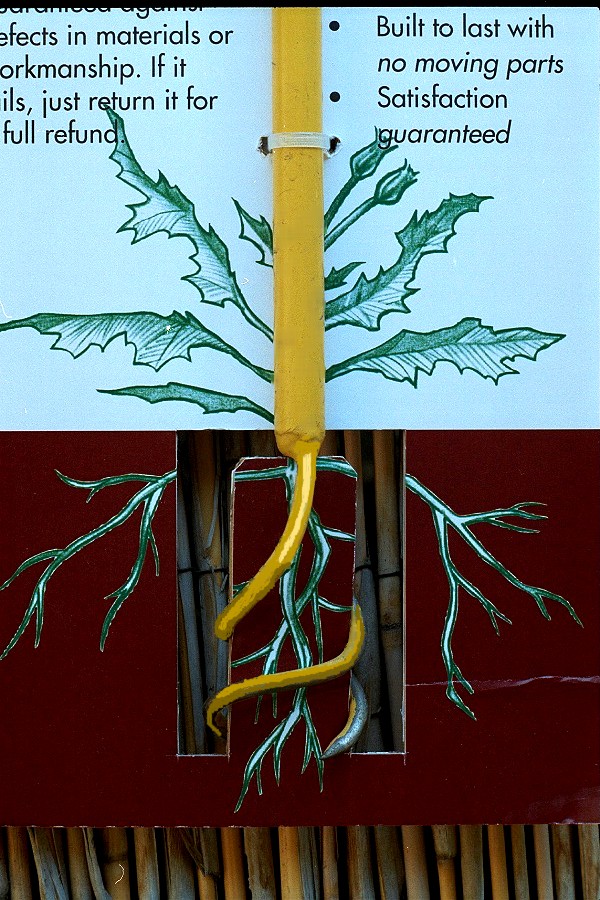
Weed Twister
36" x 2" coil diameter Click for
expanded image
If
you have some difficulty turning the blade in the
soil, you may experience a similar level of difficulty in
turning the WEED TWISTER in your soil, or
in planting and propagating new plants.
If
you can't twist your table knife in your soil at
all, or worse, if you can't even penetrate your
soil, you know the WEED TWISTER will not
work for you in this location, and about the only harvest
you can expect is an assortment of unwanted plants.
When and Where? Use the table knife
test in areas that you suspect may need some attention in your
garden. If the test is positive, meaning you can easily
rotate the knife, you don't need to recondition the soil.
This will allow you to focus on areas in your garden that are
crying out for help. Apply the table knife test at least
once a year in each area that is treated differently or that
grows different kinds of plants. Keep in mind that organic
gardening techniques discourage over-tilling your garden, because
unnecessary tilling encourages uninvited plants to join the
party. If you already have a WEED TWISTER,
you can also use the WEED TWISTER to test your
soil. The WEED TWISTER gives your more
leverage to penetrate and twist in your soil, but you should
always be careful not to catch the coils in rocks or the roots of
extra large plants.
WEED TWISTER Quality Control: Like
any tool, the WEED TWISTER is designed to withstand
a certain level of stress and torque pressure of up to 25
foot-pounds. Ergonica wants our customers to be satisfied
with this product. Use the table knife test to determine
the suitability of your soil or lawn for this product.
After you purchase the product, if you're not satisfied for any
reason, return it within 30 days for a full refund of the product
price, less shipping costs. Be sure to save your shipping
carton for returning the product, just in case. For most
homes, the WEED TWISTER will work very well for
many years and most types of weeds of reasonable size. If you need two
hands to twist the WEED TWISTER in your soil or into the
roots of a large plant and you're using the older model prior to June of 2006, your tool
may not be able to handle the
stress. The newer models have stronger steel and construction and are
designed to be twisted with one hand or two hands. For difficult soil or
deep roots, you can more easily twist with both hands using the 8-inch T-Handle Extension Kit. For more
information on the best techniques for using the WEED TWISTER, see
the Quick Tips
page at the Weed Twister website.
Bad Test Results - Now What?
Try irrigating you soil. Give it a deep soaking, and do
the test again. If the test is still negative, you may need to work you
soil with a cultivating tool.
Alternate Applications: As explained
elsewhere, the WEED TWISTER works very well for
removing new sprouts by simply scraping the soil with the WEED
TWISTER without twisting. This technique is
similar to using a circle hoe. If the soil is damp, such as
after a recent rain, your can apply this technique to
prevent the new sprouts from becoming any larger than 2-3
inches. This will work, in many cases, even in tough or
compacted soil, because you do not need to twist the coils deep
into the soil. Although you can use other tools or hoes to
scrape the soil, the WEED TWISTER is more precise
than most other tools and can protect your favored plants
from damage.